
Is Your Art a Hidden Gem? How to Tell if It’s an Original or a Print
Did you recently inherit a painting, snag a find at a consignment store, or win something at auction? Maybe you bought a piece from a local artist and now you’re wondering what it’s actually worth. Did you overpay, or did you find a hidden gem that belongs on Antiques Roadshow?
Valuing art is going to give you a million questions about the piece. How old is it, is it beautiful, who made it, Is it an original or a reproduction?. Im going to try and sum it up into just a couple of categories to start with. Really, what you want to know is if its worth anything.
Original, Reproduction, Embossing, or Print, these are your options.
The Dot Test
First start by figuring out if its a print, or if its painted image. Usually if its a print, there are signs in the resolution.
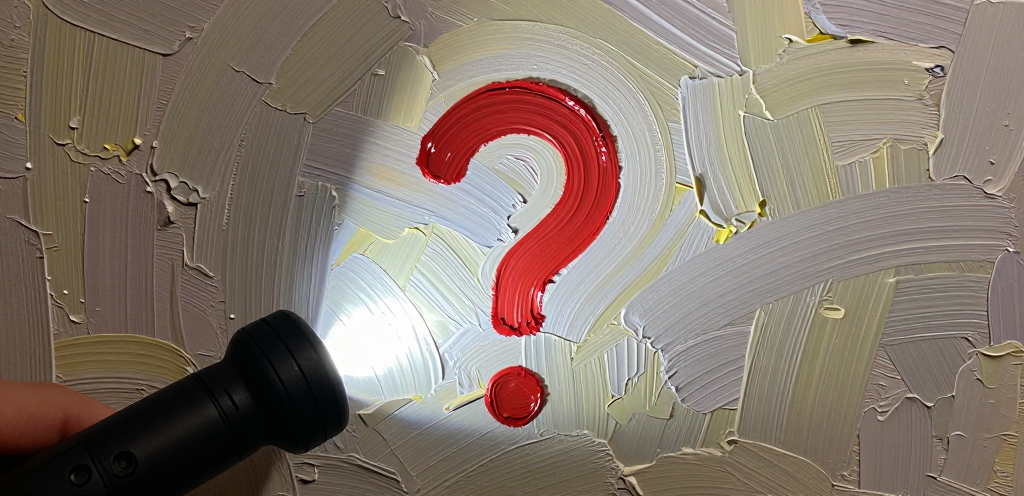
Checking painting texture with a flashlight to identify brushstrokes.
Look VERY closely at it, look for pixelation(Pixels, blocky), look for fuzzy/blurry edges.
Look for height where the brush strokes are placed; Paint is a physical medium, as each stroke is placed, it will increase in height as it stacks on the canvas.
One trick is to take a flashlight, or the flash on your phone and angle it to cast shadows across the painting.
If its not a print, then we can move onto reproduction or original.
Original vs. Auto-Paint vs. True Reproductions
The key to telling is if there is visual evidence of a process. Speaking as an artist, I have a process for every painting. There is usually an under-painting or sketch, then larger thinned washes, and then the heavier thicker paint on top. Usually White is reserved for last. Every stroke of paint should have its own directionality to it and depth. If the brush strokes to not seem to universally correspond to any sort of directionality, process, or depth, you probably have an embossing, usually a mass product painting, that either started as a print and has embellishments of paint or gesso put on top, its auto-painted, or somebody painstakingly repainted it by hand.
Read More: For a deeper look at how history affects these prices, check out my guide on Art Provenance.
What is it actually worth?
If you’ve ruled out a simple print and found evidence of a real artistic process, you likely have an original. At this point, it’s probably worth the cost of a formal appraisal to get a legitimate valuation.
If it’s a print...
Don't be discouraged. Prints can range from $0 to $500,000. It depends on the artist, the method, the age, and whether it’s signed or numbered. I currently have prints in the $2,000–$5,000 range, but I’ve also got others in the "worthless" range. It’s an exponential scale.
If it’s a reproduction...
True reproductions can sell for millions, though these are often fraudulent cases where someone is paying for faked history. This is where the line between original and reproduction blurs, which is why I always recommend a professional eye.
Pricing your own work? If you’re a creator trying to figure out your own market value, use my Time-Based Painting Value Calculator to see if your labor matches your price tag.
Next Steps: Get a Second Pair of Eyes
Google is a great starting point for researching an artist, and auction houses have great resources for valuing items. However, sometimes you just need to talk to someone who knows their way around a canvas.
If you don't have a local gallery nearby, feel free to email me a few high-resolution photos. I’m happy to take a look at the technique and help you decide if it’s worth pursuing a formal appraisal.